
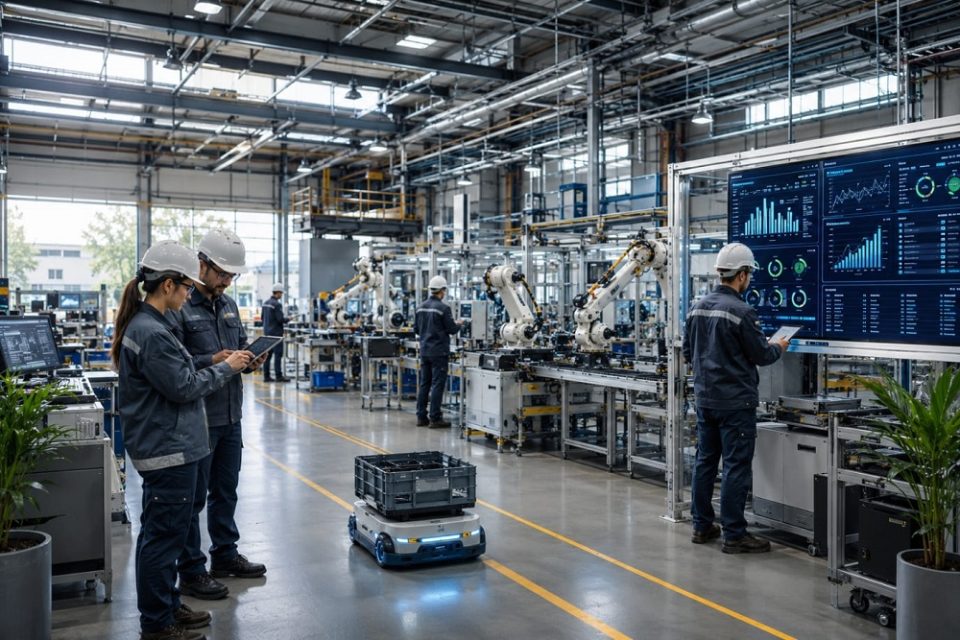
Industrial enterprises face constant pressure to increase operational efficiency, reduce overhead costs, and adapt to shifting market demands. In an economic landscape marked by supply chain complexities, fluctuating material costs, and heightened global competition, traditional manufacturing and operational models often fall short. To maintain a competitive edge, industrial organizations increasingly turn to Lean Management, a systematic methodology focused on maximizing customer value while minimizing waste.
Originating from the Toyota Production System, Lean Management has evolved into a global operational framework used across various industrial sectors, including discrete manufacturing, process engineering, logistics, construction, and software development. By focusing on continuous process optimization, quality control, and resource management, Lean Management enables companies to build resilient, cost-effective operations.
Core Principles Driving Lean Management
Understanding the full scope of Lean Management requires analyzing its foundational principles. The primary goal of Lean is not simply to cut costs, but to optimize the complete value stream from raw material acquisition to final product delivery. The methodology relies on five interconnected principles:
-
Identifying Value from the Customer Perspective: Value is defined strictly by what the end customer is willing to pay for. Any operational activity, process, or material consumption that does not directly contribute to the utility, quality, or functionality of the final product is categorized as non-value-adding.
-
Mapping the Value Stream: Organizations map every action required to bring a specific product or service from initial concept through production to delivery. Value stream mapping brings visibility to delays, bottlenecks, redundant steps, and structural inefficiencies.
-
Creating Continuous Workflow: Once non-value-adding steps are removed, production processes are re-engineered to ensure materials, information, and work items move smoothly through the plant without interruptions, buffer delays, or unexpected downtime.
-
Establishing Pull Production Systems: Unlike traditional push systems that manufacture goods based on forecasts and accumulate warehouse inventory, Lean relies on pull systems. Production is triggered strictly by real customer demand, eliminating overproduction and excess stock.
-
Pursuing Continuous Improvement: Known as Kaizen, this principle dictates that process optimization is an ongoing journey rather than a one-time project. Employees across all organizational tiers continuously identify incremental opportunities to refine workflows and eliminate waste.
Eliminating the Eight Key Wastes in Industrial Operations
The structural power of Lean Management stems from its rigorous approach to identifying and eliminating waste, referred to in Lean terminology as Muda. Industrial operations typically suffer from eight distinct types of waste that degrade profit margins and delay delivery timelines:
-
Overproduction: Manufacturing goods ahead of demand or in quantities exceeding order volumes, which ties up working capital and requires costly storage capacity.
-
Waiting Time: Idle periods caused by machine breakdowns, delayed material shipments, poor scheduling, or unbalanced assembly line bottlenecks.
-
Unnecessary Transportation: Inefficient movement of raw materials, parts, or finished goods between facilities or manufacturing cells that adds cost without adding value.
-
Inappropriate Processing: Utilizing over-engineered equipment, performing redundant quality checks, or applying unnecessary steps that exceed customer specifications.
-
Excess Inventory: Storing surplus raw materials, work-in-progress components, or finished goods, which increases storage costs, risks product obsolescence, and hides underlying process defects.
-
Unnecessary Motion: Ergonomically inefficient physical movements made by workers due to poorly organized workstations, scattered tools, or illogical factory layouts.
-
Defects and Rework: Manufacturing non-conforming items that require material scrapping, costly manual rework, or field warranty repairs.
-
Unutilized Talent: Failing to engage production line operators in problem-solving, which leads to lost institutional knowledge and lower workplace engagement.
Targeting these operational inefficiencies yields immediate and measurable improvements in factory throughput, lead times, and resource utilization.
Financial and Operational Impact of Lean Practices
Implementing Lean Management transforms industrial economics across multiple dimensions. By streamlining workflows and optimizing resource allocation, companies realize significant performance improvements that directly impact financial statements.
Optimized Inventory Management and Working Capital
Inventory represents a major expenditure for industrial businesses. Excess raw materials and unsold finished inventory tie up cash flow and incur storage, insurance, and handling expenses. By transitioning to Just-In-Time production, companies pull inventory through the factory floor strictly in response to verified customer orders. This practice minimizes raw material holdings, lowers work-in-progress stock, and releases working capital for strategic investments.
Superior Product Quality and Defect Reduction
Lean Management incorporates quality assurance directly into the manufacturing sequence rather than relying solely on end-of-line inspections. Techniques such as Poka-Yoke (mistake-proofing) and Jidoka (autonomously stopping a process when an abnormality occurs) prevent defects from passing downstream. Root-cause problem-solving frameworks, such as the Five Whys, ensure that when quality variations occur, operators address the underlying issue permanently rather than applying temporary fixes.
Enhanced Equipment Reliability and Total Productive Maintenance
Equipment failures halt production lines and cause costly operational delays. Lean incorporates Total Productive Maintenance, a strategy that engages machine operators in routine equipment checks, cleaning, and basic lubrication. Coupling operator ownership with predictive maintenance protocols maximizes overall equipment effectiveness, reduces unplanned downtime, and extends the lifespan of expensive machinery.
Reduced Lead Times and Increased Throughput
By removing process bottlenecks, streamlining workspace layouts through 5S methodology (Sort, Set in order, Shine, Standardize, Sustain), and eliminating unnecessary material transfers, industrial organizations dramatically shorten manufacturing lead times. Faster production cycles enable companies to fulfill customer orders rapidly, adapt to sudden demand spikes, and gain a competitive edge in fast-moving markets.
Scaling Lean Across Modern Manufacturing Infrastructure
As industrial enterprises integrate modern digital technologies, such as automation, IoT sensors, advanced analytics, and artificial intelligence, Lean Management principles remain essential. Digital technologies deployed in an inefficient factory only automate existing waste. However, when paired with Lean operational structures, these advanced systems amplify performance gains.
Digital Lean leverages real-time sensor data to track machine performance, monitor inventory flow across global supply chains, and identify micro-stoppages on production lines automatically. Combining analytical insights with Lean problem-solving tools enables continuous improvement teams to make data-driven decisions faster and with higher precision.
Frequently Asked Questions
What is the difference between Six Sigma and Lean Management?
Lean Management focuses primarily on eliminating waste, improving process flow, and reducing lead times across the value stream. Six Sigma focuses on reducing process variation, improving quality control, and eliminating defects using statistical analysis. Many industrial enterprises combine both methodologies into an integrated Lean Six Sigma framework to address process efficiency and defect reduction simultaneously.
How do industrial companies transition from push to pull production systems?
Transitioning from a push system to a pull system requires implementing Kanban signaling mechanisms, such as physical cards or digital notifications, that communicate precise demand requirements from downstream operations to upstream suppliers. Companies must first establish stable process times, reduce changeover durations through standardized setups, and build reliable supplier networks to prevent stockouts when operating with low safety stock levels.
Can small and medium-sized industrial enterprises successfully apply Lean practices?
Small and medium-sized enterprises often implement Lean Management more quickly than large corporations due to flatter management hierarchies and greater organizational agility. Smaller manufacturers can achieve immediate efficiency gains by applying foundational Lean tools such as 5S workspace organization, visual management boards, standard work instructions, and short daily huddle meetings without incurring large capital expenditures.
How does Lean Management contribute to environmental sustainability goals?
Lean Management aligns directly with environmental sustainability efforts by reducing the overall consumption of resources. Eliminating manufacturing defects reduces raw material scrapping, while optimizing machine usage and logistics routes lowers energy consumption and carbon emissions. Minimizing excess inventory also reduces warehouse heating, cooling, and lighting requirements, contributing to lower operational environmental footprints.
Why do some Lean Management implementations fail in manufacturing environments?
Lean implementations usually fail when management treats Lean as a short-term cost-cutting exercise or a set of technical tools rather than a long-term cultural transformation. Without leadership commitment, employee empowerment, continuous training, and an organizational culture that encourages problem-solving without blame, continuous improvement efforts lose momentum and operations revert to historical practices.
How does the 5S methodology improve workplace safety and efficiency?
The 5S framework—Sort, Set in order, Shine, Standardize, and Sustain—organizes work environments logically. By removing unused tools, assigning designated storage locations for equipment, establishing clean work areas, and standardizing maintenance routines, 5S eliminates time spent searching for items, reduces tripping hazards, improves ergonomics, and ensures that operational abnormalities or safety risks are visible immediately.
What role do frontline employees play in a Lean organization?
Frontline employees are the central driver of a Lean organization because they interact directly with manufacturing processes daily and understand operational friction points best. Lean Management empowers operators to identify waste, propose workflow improvements, participate in Kaizen events, and stop production lines when quality or safety issues arise, shifting the problem-solving responsibility from central management to the shop floor.